Sofia
One of Europe's oldest capitals — Roman remains, orthodox domes and socialist-era monumentality against a fast-changing contemporary city, with Vitosha Mountain rising directly at its edge.
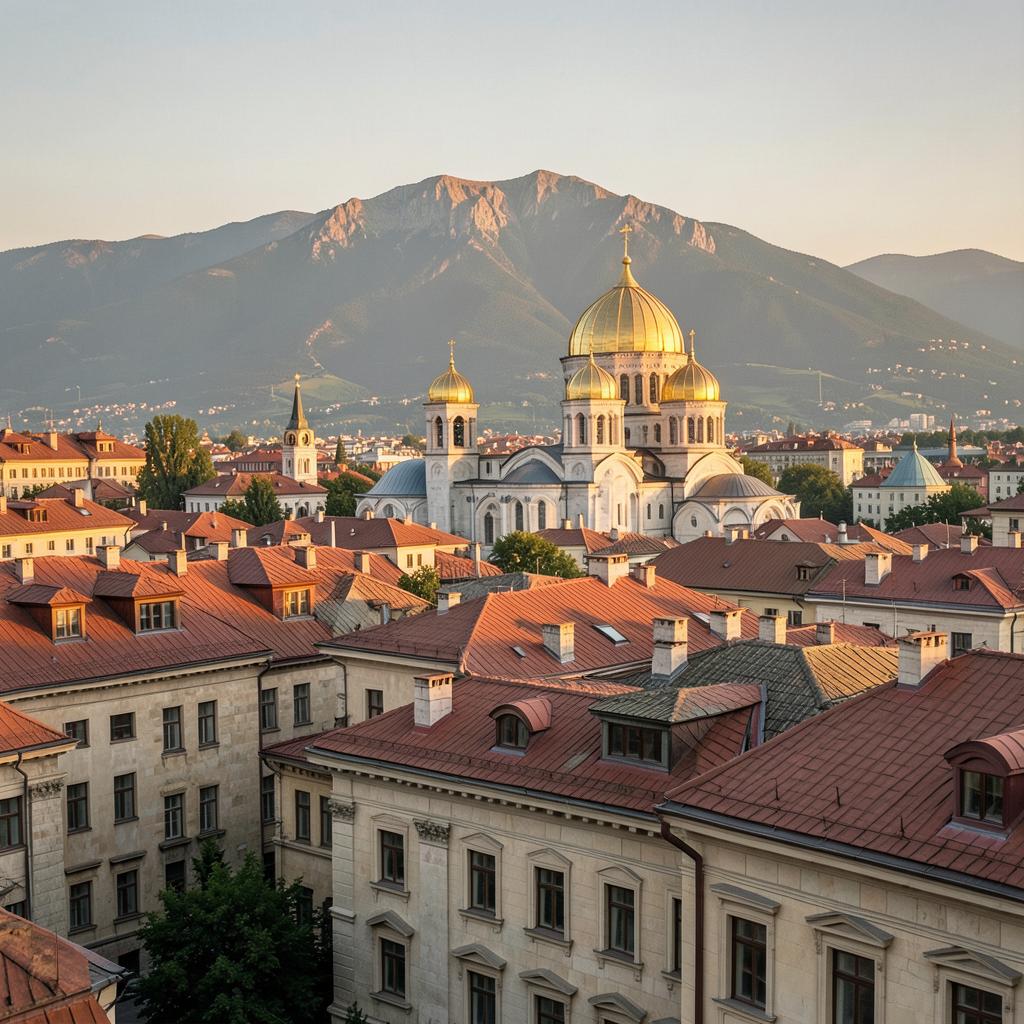
A capital since 7000 BC.
Sofia is the capital and largest city of Bulgaria. It is situated in the Sofia Valley at the foot of the Vitosha mountain, in the western part of the country. The city is built west of the Iskar river and has many mineral springs, such as the Sofia Central Mineral Baths. It has a humid continental climate.
Known as Serdica in antiquity, Sofia has been an area of human habitation since at least 7000 BC. The recorded history of the city begins with the conquest of Serdica by the Roman Republic in 29 BC. Over the centuries it passed through Roman, Byzantine, First and Second Bulgarian and Ottoman rule, serving from 1530 to 1836 as the regional capital of Rumelia Eyalet. Bulgarian rule was restored in 1878, and Sofia was selected as the capital of the Third Bulgarian State the following year.
The triangle of religious tolerance.
Sofia is the 14th-largest city in the European Union. It is surrounded by mountains such as Vitosha to the south, Lyulin to the west, and the Balkan Mountains to the north. It is the third highest European capital after Andorra la Vella and Madrid.
The city has been described as the "triangle of religious tolerance": three temples of three major world religions — Christianity, Islam and Judaism — are situated close together: Sveta Nedelya Church, Banya Bashi Mosque and Sofia Synagogue. This triangle was recently expanded to a "square" and includes the Catholic Cathedral of St Joseph.
The Boyana Church, constructed during the Second Bulgarian Empire and holding much patrimonial symbolism to the Bulgarian Orthodox Church, was included onto the World Heritage List in 1979. Sofia is home to the National Opera and Ballet of Bulgaria, the National Palace of Culture, the Vasil Levski National Stadium, the Ivan Vazov National Theatre, the National Archaeological Museum, and the Serdica Amphitheatre. The Museum of Socialist Art includes many sculptures and posters that educate visitors about the lifestyle in communist Bulgaria.
Travel & local guide.
Airport
Sofia Vasil Levski Airport (IATA: SOF, ICAO: LBSF) is the main international airport of Bulgaria, located 10 km (6.2 mi) east of the centre of the capital. The airport serves as the home base for BH Air, Bulgaria Air, European Air Charter and GullivAir, and as a base for both Ryanair and Wizz Air. There is a good connection between the airport and city center by public transport, taxi, shuttle bus and by car.
Currency & Banking
The euro (EUR) has been the official currency of Bulgaria since 1 January 2026. Exchange of foreign currency is available at Sofia International Airport and at most hotels, banks and exchange offices. International credit cards are accepted for payments in hotels, restaurants and shops. Cash payments in EUR are widely available in restaurants and shops.
Electricity
Bulgaria uses a 220 volt, 50 Hz system. Sockets have the European standard and plugs are three-prong grounded.
Entry Formalities
All foreign visitors to Bulgaria must possess a passport valid for at least the next three months. Participants requiring a visa should apply in advance to consular offices of Bulgaria in their countries in order to avoid delay when travelling to the congress.
Important Telephone Numbers
“112” is for the General Emergency call and it is also in use for the calls of Fire, Ambulance, Police, etc.
Insurance
The organisers do not accept responsibility for individual medical, travel or personal insurance. All participants are strongly advised to take out their own personal insurance before travelling to the conference.
Time Zone
Bulgaria is on the Time Zone of “Greenwich Mean Time (GMT) plus 3 hours (GMT + 3)” during Daylight Saving Time.
Weather
The temperature in Sofia in September ranges from 15 to 24 °C with an average of 20 °C. Current weather conditions can be found at www.weather.com.
Plan your visit.
Find the congress venue and address, or read the dedicated guidance for participants who require a visa.